
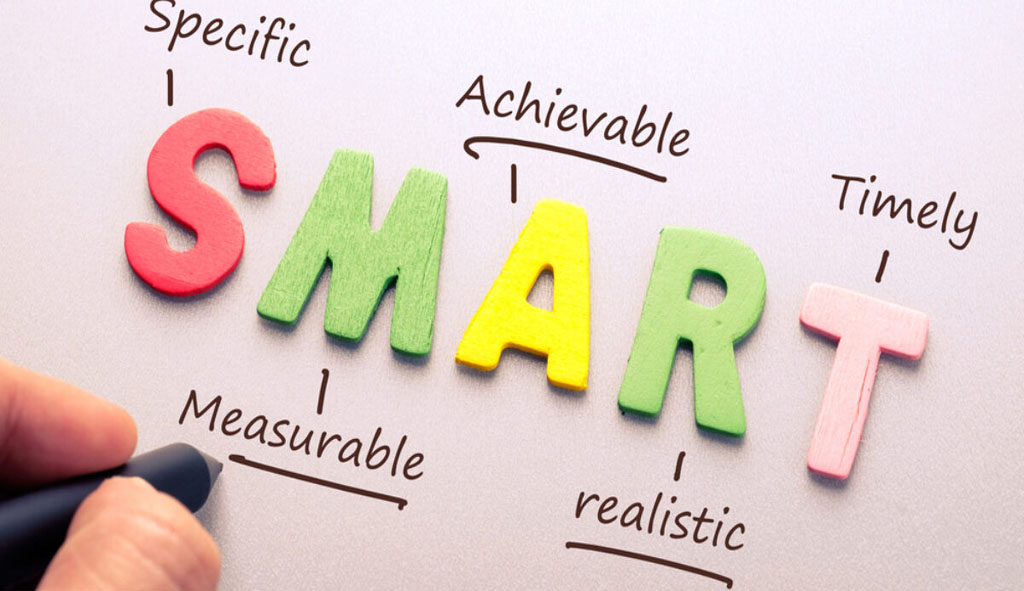
S.M.A.R.T.
Disease will never overwhelm you if your determination to be healthy is strong enough.
What Are SMART Goals?
SMART goals are a relatively new idea. In 1981, George T. Doran, a consultant and former director of corporate planning for Washington Water Power Company, published a paper called, “There’s a SMART Way to Write Management’s Goals and Objectives.” In the document, he introduces SMART goals as a tool to create criteria to help improve the chances of succeeding in accomplishing a goal.
See how Smartsheet can help you deliver on SMART goals
Smartsheet is a platform that allows individuals, teams and organizations to plan, manage, and report on work, helping you move faster and achieve your goals. See Smartsheet in action.
What Does the SMART Acronym Stand For?
The acronym stands for:
S – Specific
When setting a goal, be specific about what you want to accomplish. Think about this as the mission statement for your goal. This isn’t a detailed list of how you’re going to meet a goal, but it should include an answer to the popular ‘W’ questions:
- Who – Consider who needs to be involved to achieve the goal (this is especially important when you’re working on a group project).
- What – Think about exactly what you are trying to accomplish and don’t be afraid to get very detailed.
- When – You’ll get more specific about this question under the “time-bound” section of defining SMART goals, but you should at least set a time frame.
- Where – This question may not always apply, especially if you’re setting personal goals, but if there’s a location or relevant event, identify it here.
- Which – Determine any related obstacles or requirements. This question can be beneficial in deciding if your goal is realistic. For example, if the goal is to open a baking business, but you’ve never baked anything before, that might be an issue. As a result, you may refine the specifics of the goal to be “Learn how to bake in order to open a baking business."
- Why – What is the reason for the goal? When it comes to using this method for employees, the answer will likely be along the lines of company advancement or career development.
M – Measurable
What metrics are you going to use to determine if you meet the goal? This makes a goal more tangible because it provides a way to measure progress. If it’s a goal that’s going to take a few months to complete, then set some milestones by considering specific tasks to accomplish.
A – Achievable
This focuses on how important a goal is to you and what you can do to make it attainable and may require developing new skills and changing attitudes and habits. The goal is meant to inspire motivation, not discouragement. Think about how to accomplish the goal and if you have the tools/skills needed. If you don’t currently possess those tools/skills, consider what it would take to attain them. (With the SMART pH Protocol in the members area, we will help and guide you to attain what you need to achieve your goal.)
R – Relevant
Relevance refers focusing on something that makes sense with the goals. For example, if the goal is to become healthy again, it should be something that’s in alignment with the overall goal objectives. Remember, your life depends on this.
T – Time-Bound
Anyone can set goals, but if it lacks realistic timing, chances are you’re not going to succeed. Providing a target date for your goal is imperative. Asking specific questions about the goal deadline and what can be accomplished within that time period. If the goal will take three months to complete, it’s useful to define what should be achieved half-way through the process. Providing time constraints also creates a sense of urgency.
The Easiest Way to Write SMART Goals
When it comes to writing SMART goals, be prepared to ask yourself a lot of questions. The answers will help fine-tune your strategy, ensuring the goals are something that’s actually attainable. While you should be as realistic as possible, it’s important to approach writing SMART goals with a positive attitude. After all, this is something that you want to achieve.
 This doesn’t have to be a daunting experience; in fact, it should be quite illuminating.
Execute on SMART Goals with SMART pH Protocol
Once you’ve defined your SMART goals, it’s essential to put a plan in place to achieve them. To help with execution, you need a tool that enables you to plan, track, manage, automate, and report on your goals in real-time.
One such tool is the SMART pH Protocol, a work execution platform that enables individuals to get from idea to impact - fast. With a collaborative, real-time objectives tracker in the SMART pH Protocol, you can increase transparency and improve accountability across your initiatives.
Use the SMART pH Protocol to create consistent goal elements, increase speed, and improve collaboration with scalable options that fit individual preference. Hold yourself accountable, improve visibility into your priorities, and ensure nothing slips through the cracks.
Discover how the SMART pH Protocol can help maximize your goal management efforts, today.
Establishing Clarity Around Success and Failure of Goals
Empower yourself to go above and beyond with a flexible platform designed to match the needs of your goal — and adapt as those needs change.
The SMART pH Protocol makes it easy to plan, capture, manage, and report on work from anywhere, helping you to be more effective and get better results. Report on key metrics and get real-time visibility into work as it happens with roll-up reports, dashboards, and automated workflows built to keep you connected and informed.
When you have clarity into the work getting done, there’s no telling how much more you can accomplish in the same amount of time.